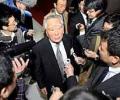
Chairman of Japan's Suzuki Motor Corporation Osamu Suzuki on Monday visited the violence-hit Manesar plant of the company's Indian arm Maruti Suzuki.

The Invicto hybrid, priced at Rs 24.79 lakh (Rs 2.479 million), is a Multi-Purpose Vehicle, which is based on the Toyota Innova Hycross.

Maruti Suzuki's contribution to the sales revenue of its Japanese parent, Suzuki Motor Corporation (SMC), has touched the highest-ever figure during April-December of FY23. According to SMC's results declared on Tuesday, Maruti's share in its global revenues jumped from 33.42 per cent in April-December of FY22 to 40.93 per cent in the corresponding period of FY23.

A potential US-Iran peace deal, expected to be signed on June 19, is anticipated to ease geopolitical stress and benefit various sectors, particularly in India, with analysts suggesting investors await finer details before making significant moves.
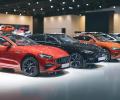
The India-EU free trade deal could help Indian-made cars enter Europe at lower costs and challenge Chinese dominance.

Suzuki chief Osamu Suzuki, on a visit to India, said that the companies would not only expand operations and production in the domestic market but gradually use it as a base for exports to other regions, primarily Europe.
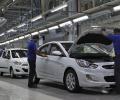
Domestic passenger vehicle dispatches from companies to dealers rose 13 per cent year-on-year to 449,616 units in January with demand remaining robust owing to GST rate rationalisation and subsequent dip in prices, industry body SIAM said on Friday.

The next many decades belong to India as the global economic powerhouse, and it will be essential to continue demonstrating policy stability, as the country aspires to be the world's manufacturing hub, Maruti Suzuki India MD and CEO Hisashi Takeuchi said on Friday.

Fuel prices have risen by about Rs 7.5 per litre since May 15, as global crude oil prices surged due to the ongoing conflict in West Asia and supply concerns around the Strait of Hormuz.

Benchmark equity indices Sensex and Nifty rebounded on Thursday after three sessions of losses, tracking gains in global markets after US President Donald Trump struck a conciliatory tone on Greenland. In a volatile session, the 30-share BSE Sensex climbed 397.74 points, or 0.49 per cent, to close at 82,307.37.

Maruti Suzuki's royalty payments to its Japanese parent Suzuki are "extortive" and the amount paid has increased over six times per car sold over the past 15 years, according to a report.
Maruti Suzuki has outperformed Suzuki Motor Corp in terms of profitability, with the Japanese parent today posting a consolidated net profit of 28.91 billion yen (about Rs 1,395 crore) for the fiscal 2009-10, almost half of that of the India's largest carmaker.

With demand continuing to be strong post the festive season, leading automakers, Maruti Suzuki, Tata Motors and Mahindra & Mahindra, saw robust growth in sales in November as compared to the same month last year. Maruti Suzuki India reported the best-ever total sales, including exports, last month at 229,021 units, a year-on-year growth of 26 per cent as compared to November last year.
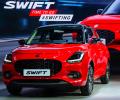
Swift Dzire has clocked 2.5 million in sales, and you might, in a non-too-distant future, see headlines that the DZire has done 3 million as well, observes Suveen Sinha.
The proposal was cleared by FIPB at its meeting on March 30, 2005.\n\n

Market sentiment is likely to remain cautious as investors position themselves for the upcoming Union Budget and the US Fed's interest rate decision, where expectations are muted.

Indian stock markets saw a significant rebound, with the Sensex jumping nearly 790 points, primarily fuelled by strong buying interest in telecom, pharma, and private banking shares, despite a volatile trading session and a weakening rupee.

Japanese agri-equipment firm Kubota is taking cues from Suzuki Motor's strategy to establish India as its global production hub, according to a report by Nikkei Asia. The acquisition of Escorts in 2022, leading to the rebranding as Escorts Kubota, a prominent tractor manufacturer in India, which held the fourth-largest global market share, offered Kubota a crucial foothold in the Indian and international markets, complementing its strengths with Escorts' established presence.

In October, small car wholesales of the auto industry -- excluding Tata Motors -- went up by 8.4 per cent Y-o-Y to 116,601 units, the data showed. However, the utility vehicle (UV) segment which includes sports utility vehicles (SUVs) as well as multi-purpose vehicles (MPVs), saw a bigger growth in October.
Maruti's decision to give the Gujarat plant to Suzuki may not be the proverbial win-win amid concerns about costly imports and pricing.
Indian benchmark equity indices, Sensex and Nifty, closed lower due to investor caution over rising bond yields, a weaker rupee, and fresh fuel price hikes, which have revived inflation concerns.
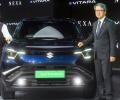
MSIL, which currently has a subscription service that allows customers to lease its petrol-run and strong hybrid vehicles on a flexible, long-term basis without ownership commitments, will introduce a leasing service as well.

Tata Motors' 2026 Tiago facelift is a tech-loaded and safety-focused entry-level hatchback, with prices starting at Rs 4.69 lakh.
Maruti Suzuki India Ltd, the country's biggest carmaker, is set to play a larger role in the operations of parent Suzuki Motor and will contribute a third of the Japanese company's global sales by 2009-10, the Indian firm's managing director Shinzo Nakanishi said on Thursday.

India's consumption stocks, which have outperformed the broader market, are now facing significant pressure due to a gradual rise in fuel prices and the potential for higher inflation. Analysts warn that companies may be forced to pass on increased input costs to consumers, potentially hurting demand across both staples and discretionary categories, with a looming threat of deficient monsoon rainfall further exacerbating inflationary concerns.
Maruti Udyog Ltd on Thursday announced that it would buyout Suzuki in Maruti Suzuki Automobile India Ltd and merge the subsidiary into itself.

'We are seeing a lot of people with helmets visiting our showrooms.'
Maruti's hike in royalty to its parent Suzuki, at a time when competition is speeding up, makes it a decidedly uncool stock.
India needs to come together to deal with the 50 per cent punitive US tariffs on Indian products and stand up to any kind of bullying, Maruti Suzuki India chairman R C Bhargava said on Thursday. "It is our duty as Indians to do our very best to promote and maintain our dignity and respect and not give in to any kind of bullying in this matter... the nation has to stand united," Bhargava said at the company's 44th Annaul General Meeting in New Delhi.

A deep split has emerged within India's auto industry over the proposed CAFE exemption for small cars, with only Maruti Suzuki and Renault backing the move in the final SIAM vote.
Maruti Suzuki India (MSIL) will issue equity shares on a preferential basis to parent Suzuki Motor Corporation (SMC) to acquire 100 per cent stake in the latter's Gujarat plant. This deal is expected to increase the share base of MSIL by about 4 per cent. And consequently, it will raise SMC's shareholding in Maruti by around 1.8 percentage point. "Whether it is in terms of PAT (profit after tax) or earnings per share (EPS) or dividend per share (DPS) of MSIL, the share-swap option will give shareholders a better deal than any other option such as cash payment," MSIL chairman RC Bhargava told reporters during a press conference.

The Narcotics Control Bureau (NCB) has busted a major international narcotics ring, seizing 349 kg of high-grade cocaine worth Rs 1,745 crore in Mumbai.
Equity benchmark indices Sensex and Nifty rebounded sharply by nearly 1 per cent on Monday, driven by strong buying in power, banking, and financial stocks.

Manufacturers of passenger vehicles (PVs) in the first half of the calendar year (2025) reported a modest 0.5 per cent year-on-year increase in wholesale dispatches, while retail sales grew 2.5 per cent for the same period, reflecting a calibrated approach by automakers amid elevated dealership inventories and cautious consumer sentiment. According to the Society of Indian Automobile Manufacturers (Siam), dispatches rose marginally to 2.16 million units, up from 2.15 million units a year earlier.
Tata Motors is the leader in the electric car market with about 62 per cent share.

Indian automakers are reviving legacy nameplates to leverage brand recall and stand out in a crowded market, as classic badges like Sierra, Safari, Baleno and Scorpio return to attract buyers.

Maruti Suzuki and Hyundai Motor India on Monday reported a dip in passenger vehicle dispatches to dealers in the domestic market last month as the companies tried to adjust vehicle inventory amid slowing demand. Maruti Suzuki India said it "calibrated supplies" to the dealers, aligning with the industry's retail sales projections amid India-Pakistan conflict and a dip in sales of entry-level cars.

Mexico on Thursday imposed a tariff of up to 50 per cent on imports from its non-preferential trade partners, including India, a move that might hit New Delhi's annual $5.75 billion shipments to its third-largest car export market.

'The market is still very bullish. The demand is so strong that for eight models, we have no units in our factories to dispatch to dealers,' said Partho Banerjee, senior executive officer, marketing & sales, Maruti Suzuki India (MSIL).
